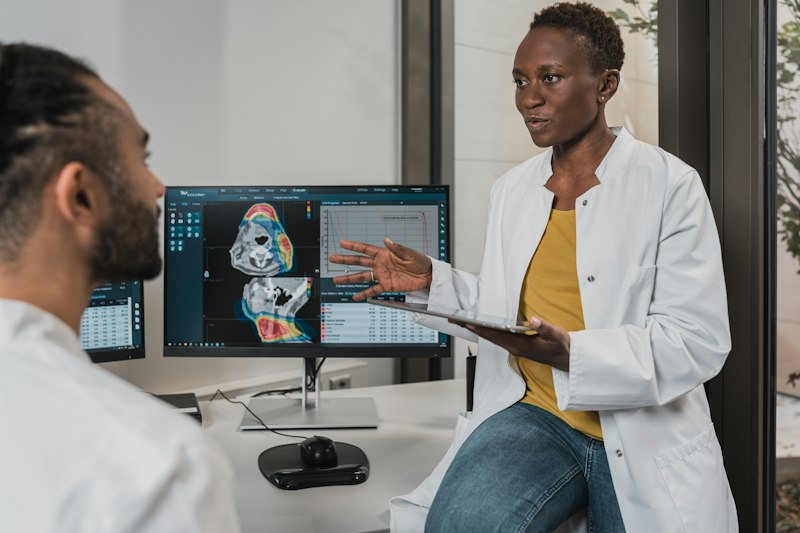
A hospital digital twin is a computer model of how patients, staff, beds and equipment move through a hospital, built from the hospital's own data, that leaders use to test changes before making them. Want to know whether adding 20 beds will cut emergency boarding, or whether moving elective surgery to Saturdays will smooth ward occupancy? A digital twin runs the scenario thousands of times on the model rather than on real patients.
The term is used loosely. For capacity planning, most real "digital twins" are discrete event simulation models: a well-established operations research technique, now fed with richer hospital data and wrapped in better software. That is useful, but it is not magic, and research reviews in 2025 still describe hospital digital twins as early-stage.
This guide explains what the technology does, how it works, where hospitals have actually used it, what the research says, and how a mid-sized Indian hospital or group can get the benefit without a large programme.
What a digital twin is (and is not)
In manufacturing, a digital twin often means a live, sensor-fed replica of a machine. In hospital operations, the term usually covers three related things:
- A simulation model of patient flow, built from historical data, used for "what if" planning.
- A connected model that is refreshed with recent data so its baseline stays current.
- A live operational view (closer to a command centre dashboard) that some vendors also call a twin.
For capacity planning, the first two matter. The model does not run the hospital; it helps people decide.
How the simulation works
Discrete event simulation models the hospital as a series of events: a patient arrives in emergency, waits, is assessed, is admitted, waits for a bed, moves to a ward, has surgery, recovers, is discharged. Each event takes a variable amount of time, drawn from distributions learned from real data.
GE HealthCare describes its Digital Twin as a discrete event simulation that learns the statistical behaviours of patients, staff and resources rather than relying on averages, with a typical project lasting about five months, according to its February 2025 article.
The core inputs are:
| Input | Example data source |
|---|---|
| Arrivals by hour, day and season | ED registrations, OPD, admissions |
| Patient pathways | ADT events, transfers between units |
| Length of stay distributions | IPD records by diagnosis or specialty |
| Resource capacity | Beds by ward, OT schedule, ICU beds |
| Staffing rules | Nurse ratios, shift patterns |
| Process times | Bed cleaning, discharge, transport |
The model is validated by checking that it reproduces past performance (for example, last year's occupancy and ED boarding) before anyone trusts its predictions.
What hospitals use it for
Typical questions a twin answers:
- Bed capacity: how many beds a ward needs to keep boarding under a target, given seasonal demand.
- Surge planning: when a seasonal spike is likely to hit and how many extra beds and staff it will need.
- Elective scheduling: how smoothing surgical schedules across the week changes ward occupancy.
- New builds and expansions: sizing and layout of new units before construction.
- Process changes: the effect of earlier discharges, faster bed cleaning or a discharge lounge.
GE HealthCare reports that Children's Mercy Kansas City uses its model to forecast pediatric respiratory surges (when they will hit, which diagnoses will dominate and what resources are needed), and that AdventHealth used simulation to plan the design of a 12,000-square-foot command centre. These are vendor-reported uses without published numeric outcomes.
What the research says
The research picture is honest about the gap between promise and proof.
- Most work is still simulation-only. A 2025 scoping review in the Journal of Medical Internet Research on digital twins for clinical and operational decision-making found that only a minority of studies tested systems in real environments; most were evaluated in simulated settings.
- Academic prototypes are maturing. The University of Oslo's BedreFlyt project built a digital twin for ward bed-bay allocation and evaluated it on a realistic scenario using a hospital ward's historical data, as described in its May 2025 arXiv paper.
- Published outcome data is thin. Strong before-and-after results from twins specifically are rare; most benefits are reported by vendors or as planning decisions made.
Digital twin vs simpler tools
Many capacity questions do not need a full twin. Choose the simplest tool that answers your question.
| Question | Simplest adequate tool |
|---|---|
| What was occupancy by ward last year? | Reporting dashboard |
| How many admissions next week? | Time-series forecast |
| Are we short of beds on Mondays? | Occupancy analysis by weekday |
| Will 20 new beds fix ED boarding? | Simulation model |
| How should a new block be laid out? | Simulation plus layout modelling |
| What happens if three changes combine? | Simulation model |
Simulation earns its cost when changes interact, variability matters, and decisions are expensive to reverse, such as construction.
The Indian context
Indian hospital groups are expanding quickly, with new blocks, new branches and conversions of wards into ICUs or day-care units. These are exactly the decisions where a few months of modelling can prevent expensive mistakes. But the data foundation is often the bottleneck:
- Timestamps are incomplete. Many HMS deployments record admission and discharge dates but not bed-ready, discharge-order and departure times.
- Pathways are not captured. Transfers between wards may not be recorded as events.
- Seasonality is local. Monsoon-related fevers, festival seasons and local epidemics affect demand in ways national data will not show.
A hospital that fixes these data gaps gets value twice: better daily operations now, and a reliable basis for simulation later. Our guide to healthcare data analytics for hospitals covers that foundation.
How to start without a big programme
- Pick one expensive decision. A new ICU, an OT expansion, a new ward block, or a change to elective scheduling.
- Check your data. You need at least 12 months of admissions, transfers, discharges and OT data with reliable timestamps.
- Map the pathway. Draw how patients move for the decision in question, with clinical and nursing leads.
- Build a focused model. Model only the units involved, not the whole hospital.
- Validate against history. The model should reproduce last year's occupancy and waits within a reasonable margin.
- Test scenarios. Compare options, including doing nothing and process changes that cost less than construction.
- Decide, then check. After implementing, compare real results with the model's prediction and refine.
A worked example: should we add ICU beds?
Here is an illustrative case (the numbers are placeholders, not benchmarks) showing how a focused model supports a real decision. A 300-bed hospital is considering converting a 12-bed general ward into a step-down unit, because post-operative patients often wait in recovery for an ICU bed, delaying the next surgeries.
- Question: will a step-down unit reduce recovery-room holds enough to protect the OT schedule, and what happens to general ward occupancy?
- Data: 18 months of OT completion times, ICU admissions and discharges, step-down eligibility (judged retrospectively by intensivists on a sample), ward transfers and discharge times.
- Baseline check: the model reproduces last year's ICU occupancy and recovery-room holds closely enough that clinicians agree it "looks like our hospital".
- Scenarios: (a) do nothing; (b) convert 12 beds to step-down; (c) keep the ward but move ICU discharges earlier in the day; (d) combine (b) and (c).
- Reading the results: the model may show that earlier ICU discharges alone cut most of the holds at almost no capital cost, while the conversion helps further but pushes general ward occupancy into the range where emergency boarding rises.
- Decision: the hospital might start with the process change, monitor results for three months, and revisit the conversion with real data.
The point is not the specific answer. It is that the model makes trade-offs visible, including knock-on effects on other units that a spreadsheet would miss.
Costs and what drives them
Costs depend on scope more than software. The main drivers are:
- Data preparation: cleaning and linking HMS, OT and ED data is usually the biggest effort.
- Modelling expertise: operations research or simulation skills, in-house or from a partner.
- Scope: one unit or pathway versus a whole hospital or group.
- Software: commercial simulation platforms or open-source libraries in Python.
- Keeping it current: refreshing data and re-validating if you want an ongoing twin rather than a one-off study.
A focused one-decision study is a sensible first step; a continuously updated twin makes sense for large groups that make capacity decisions often.
Common mistakes
- Starting with the whole hospital. Scope creep makes models slow, opaque and hard to validate.
- Skipping validation. If the model cannot reproduce last year, its predictions are guesses.
- Ignoring variability. Planning with averages hides the peaks that cause boarding.
- Treating results as precise. Use ranges and compare options, not single-number forecasts.
- No clinical involvement. Nurses and doctors know pathways and constraints that data misses.
Where it connects to daily operations
A digital twin is a planning tool. Its natural partners are a hospital command centre for daily flow decisions and an AI-driven operating theatre schedule for elective demand. All three rely on the same clean bed, ADT and OT data in the hospital management system.
At Algon, we help hospitals get that data right, build analytics on top through health data analysis and machine learning work, and develop focused simulation models for specific decisions in Python, connected to the hospital management system.
Conclusion
A hospital digital twin, for capacity planning, is a simulation model of patient flow built from your own data. It is genuinely useful for expensive, interacting decisions such as new beds, new blocks and surge planning, and vendors report real hospitals using it. But the research base is still early, and the model is only as good as the timestamps behind it. Fix the data, start with one decision, validate honestly, and treat the results as a better-informed range, not a prophecy.
Frequently asked questions
What is a hospital digital twin?
A computer model of how patients, staff, beds and equipment move through a hospital, built from the hospital's own data and used to test changes such as adding beds or changing schedules before making them.
How does a hospital digital twin work?
Most capacity-planning twins use discrete event simulation. They model arrivals, pathways, lengths of stay and process times as variable events learned from historical data, then run scenarios many times to compare outcomes.
Is there evidence that hospital digital twins work?
Evidence is early. A 2025 JMIR scoping review found most digital twin studies were evaluated in simulated settings rather than real hospitals. Vendors report real uses, such as surge planning at Children's Mercy Kansas City, without published numeric outcomes.
What data do you need for a hospital digital twin?
At least 12 months of reliable arrivals, admissions, transfers, discharges, OT schedules and process timestamps, plus bed capacity and staffing rules. Incomplete timestamps are the most common problem.
When is a digital twin worth the cost?
When decisions are expensive and hard to reverse, such as construction or ICU expansion, and when several changes interact. Simple questions are better answered with dashboards or forecasts.
How long does a digital twin project take?
GE HealthCare describes typical projects lasting about five months. A focused model of one unit or decision can be faster if the data is already clean.